
Project description
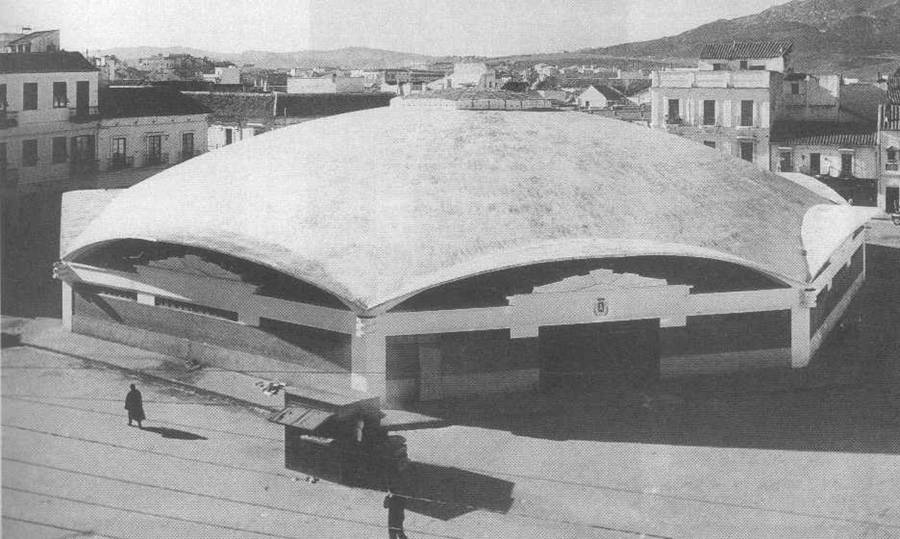
The Algeciras Municipal Market was built to a design by the architect Manuel Sánchez Arcas and the engineer Eduardo Torroja Miret, and was completed at the end of 1934 or the beginning of 1935.
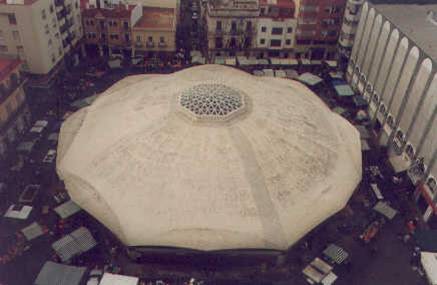
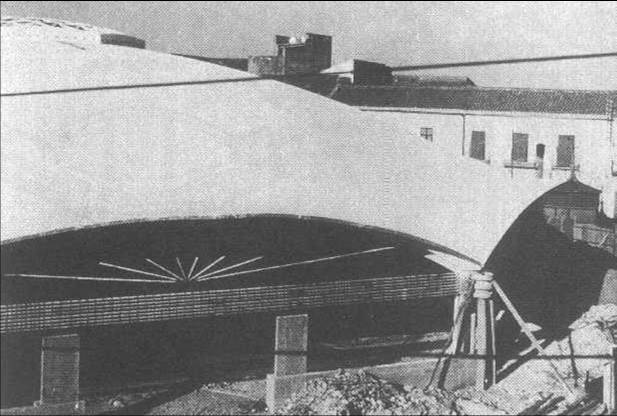
The structure of the Market consists of three main elements: a spherical dome with eight peripheral stiffening vaults; the system supporting the dome at eight points, made up of eight columns and a tension ring; and, finally, the footings of the eight columns.
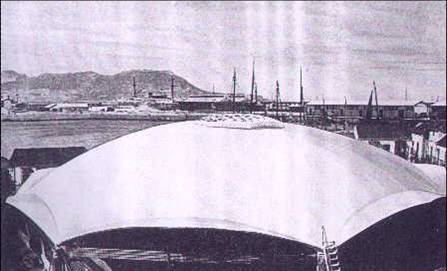
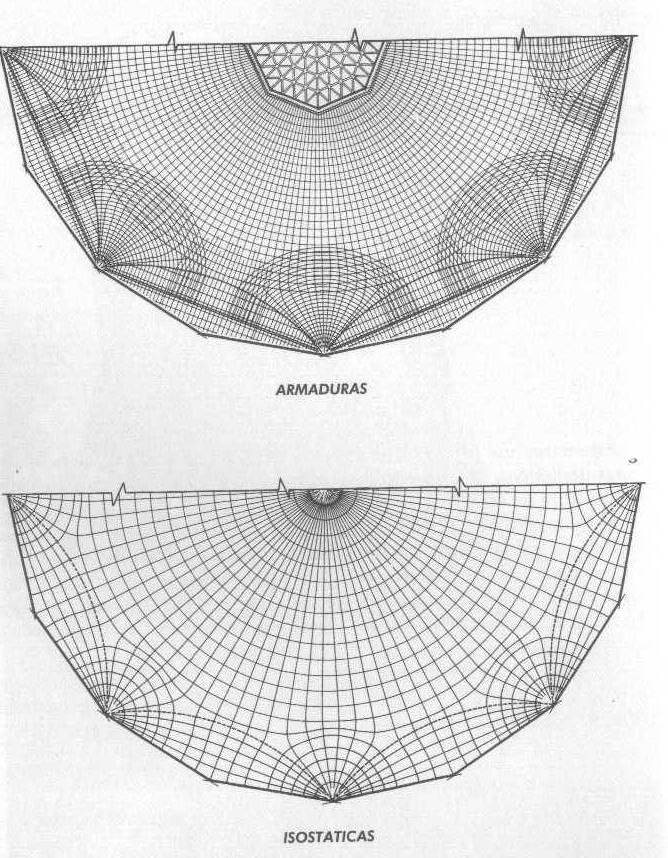
The dome is a spherical cap with an outer diameter of 47.76 m and a radius of curvature of 44.10 m. Its main originality is that it rests on only eight points, using cylindrical vaults with radial axes as stiffening elements, and that it is open at the centre with a 10 m diameter skylight. The dome is 10 cm thick over the whole inner cap up to its intersection with the edge vaults, increasing to about 50 cm at the corners of the spherical triangles resting on the columns.
The dome is supported at the eight corners formed where the cylindrical vaults meet the dome. At each of these points, the dome transmits a vertical force and a horizontal radial force. To resist these two main forces, the support system has two elements: vertical columns and an octagonal tension ring.
The role of the octagonal tension ring is to resist the horizontal thrust of the dome. The difficulty with this way of resisting the thrust is that, to work properly, the dome needs radial forces that counteract the thrust and shorten its perimeter in plan, whereas the tension ring that produces those radial forces can only do so by lengthening, and therefore lengthening the perimeter of the dome in plan. Torroja, ahead of his time, solved this incompatibility of deformations by prestressing, although in a very different way from how prestressed concrete has been used in recent decades. The solution was to place the steel bars of the ring, 16 bars of 30 mm diameter, without concrete and fitted with turnbuckles, so that, with the dome still on its falsework, all the bars forming the ring were tightened and shortened until they produced forces that balanced the thrust of the dome and began to shorten it and lift it off the falsework. Once this was achieved, the ties were concreted.
It is interesting to note that the concrete of the perimeter ring has no structural function: it only protects the reinforcement against corrosion and acts as thermal insulation. Unlike modern prestressed concrete elements, the concrete of the ring is neither in compression nor in tension.