
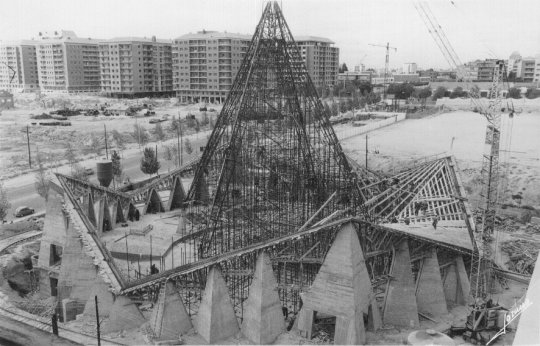
Project description
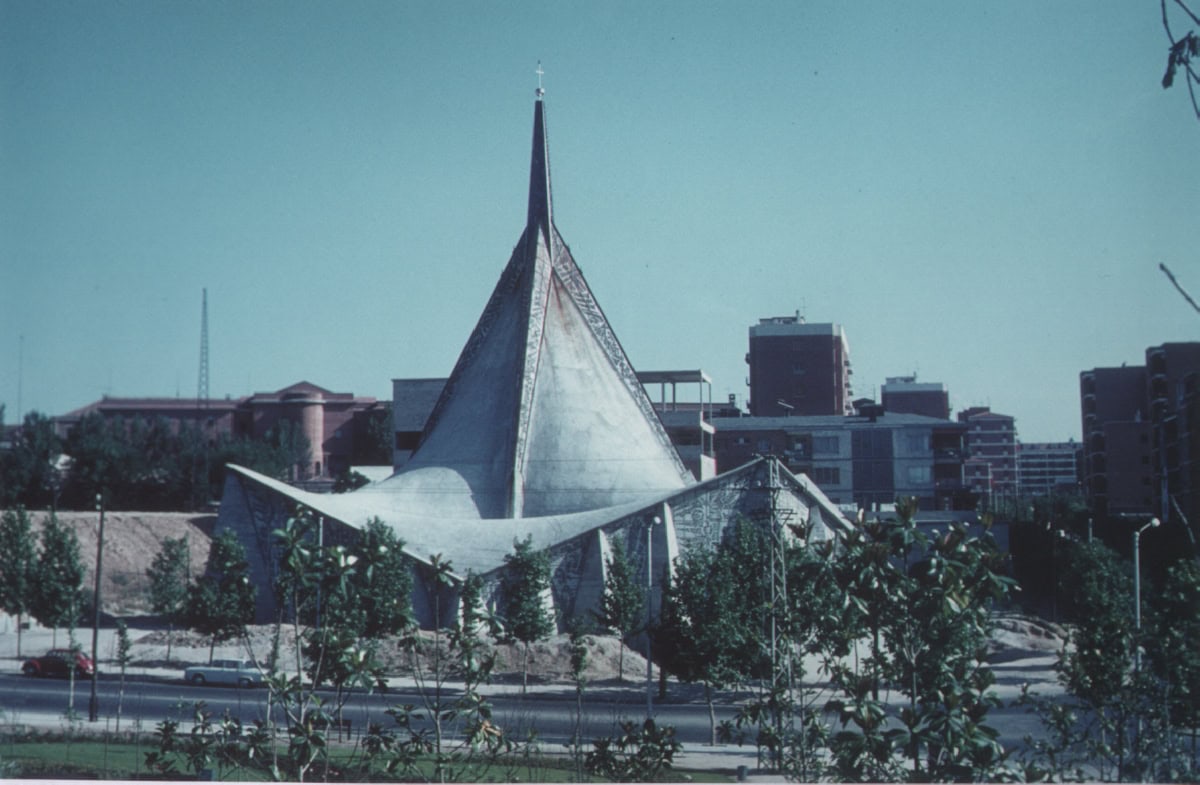
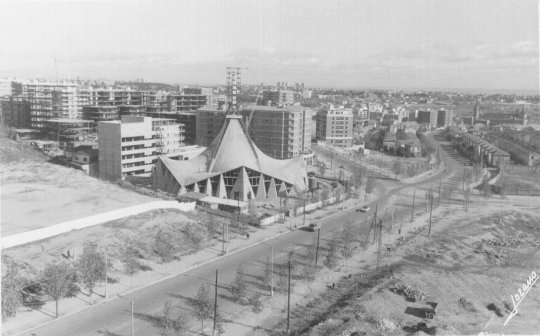
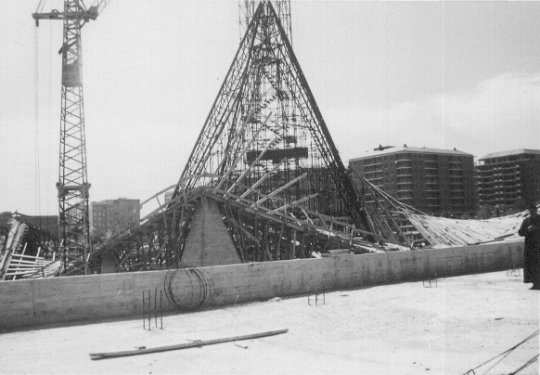
The Church of Nuestra Señora de Guadalupe stands on Calle de Puerto Rico, in Madrid’s Chamartín district. Although the foundation stone was laid in 1961, the church was not completed until 1965.
Construction was directed by the architects Félix Candela and Enrique de la Mora, with the collaboration of José Ramón Aspiazu and the engineer José Antonio Torroja Cavanillas.
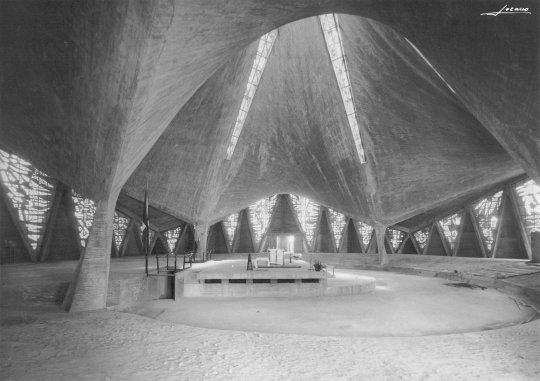
Octagonal in plan, it occupies a circle 55 metres in diameter. Its roof is a shell structure made up of eight hyperbolic paraboloids, no more than 4 cm thick. The side enclosure, a 2 cm folded plate combined with stained-glass windows, carries the weight of the roof together with four hollow central columns.
Local residents call it “the Mexican hat”, although the intention was in fact to evoke the tent of Abraham, where all must fit.
Candela was a disciple of Eduardo Torroja and inherited his master’s concern for beauty. He made this clear at an engineering symposium: “Nobody talks about beauty, perhaps because it cannot be measured and engineers have a professional bias towards dealing only with facts... However, we should remember that much of the success of these structures is due to the fact that they are generally very beautiful and therefore answer a subconscious longing of mankind.” This is easy to see in Nuestra Señora de Guadalupe. The church is a round, open theatre, resting on just four slender columns. The stained glass, with Aztec echoes, lights up the concrete, which still bears the marks of the formwork. The huge space feels modern and mystical at the same time. The paraboloids never quite meet at the top of the hat, joined only by a thin band of coloured glass. And visitors, at the risk of sacrilege, cannot help wondering: how on earth does it stand up?
El País, 5 April 2010.