
Project description
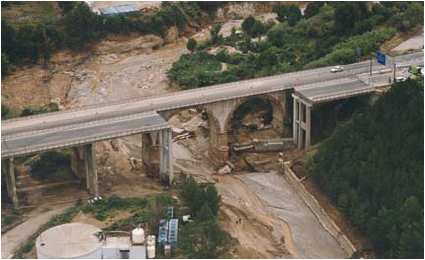
The torrential rain that fell on 9 June 2000 on the catchment of the Riera Magarola, in the municipality of Esparraguera, caused the collapse of one of the central piers of the bridge over the stream on the Barcelona-bound carriageway of the N-II. As a result, the deck spans resting on that pier also collapsed.
The State Roads Authority in Catalonia immediately declared an emergency and awarded the project “Emergency works on the N-II dual carriageway, km 565+000 to km 582+300” to the consultants Carlos Fernández Casado S.L. and José A. Torroja Oficina Técnica S.A.
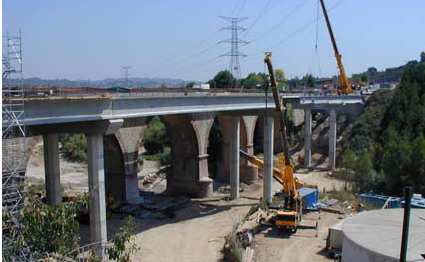
Since the foundations of the undamaged piers could be compromised by another flood, and the collapsed bridge had already been widened after its original construction, it did not seem appropriate to rebuild the collapsed pier and decks. Instead, they were to be demolished and a new bridge built that would take into account not only the new actions required in the road bridge design code in force since 1996, but also the possible scour risks after another flood like the one in June.
On this basis, a bridge with a total length of 168.5 m was designed, divided into 5 spans of 26.0+23.0+46.0+46.0+26.6 m. It is a precast prestressed concrete beam bridge. The horizontal alignment of the original bridge was kept so as not to affect the approaches. The 13.5 m wide deck can take three 3.5 m lanes, 1.15 m side shoulders and two reinforced concrete edge parapets with a steel handrail.
The deck section consists of 4 I-beams in spans 1, 2 and 5 and 7 I-beams in spans 3 and 4. All the beams are 2.05 m deep, with a 0.25 m thick reinforced concrete slab cast in situ on top.
The piers have twin octagonal shafts, with heights varying between 13.5 and 16.9 m. The foundations are deep, on 1.5 m diameter piles, except at pier 1, where the loads are transferred directly to the ground through a spread footing.
The abutments are of the pile-column type. All the bearings at piers and abutments are laminated elastomeric bearings.